Blank Phone Number For Utah State Tax Commission Form
Blank Phone Number For Utah State Tax Commission Form
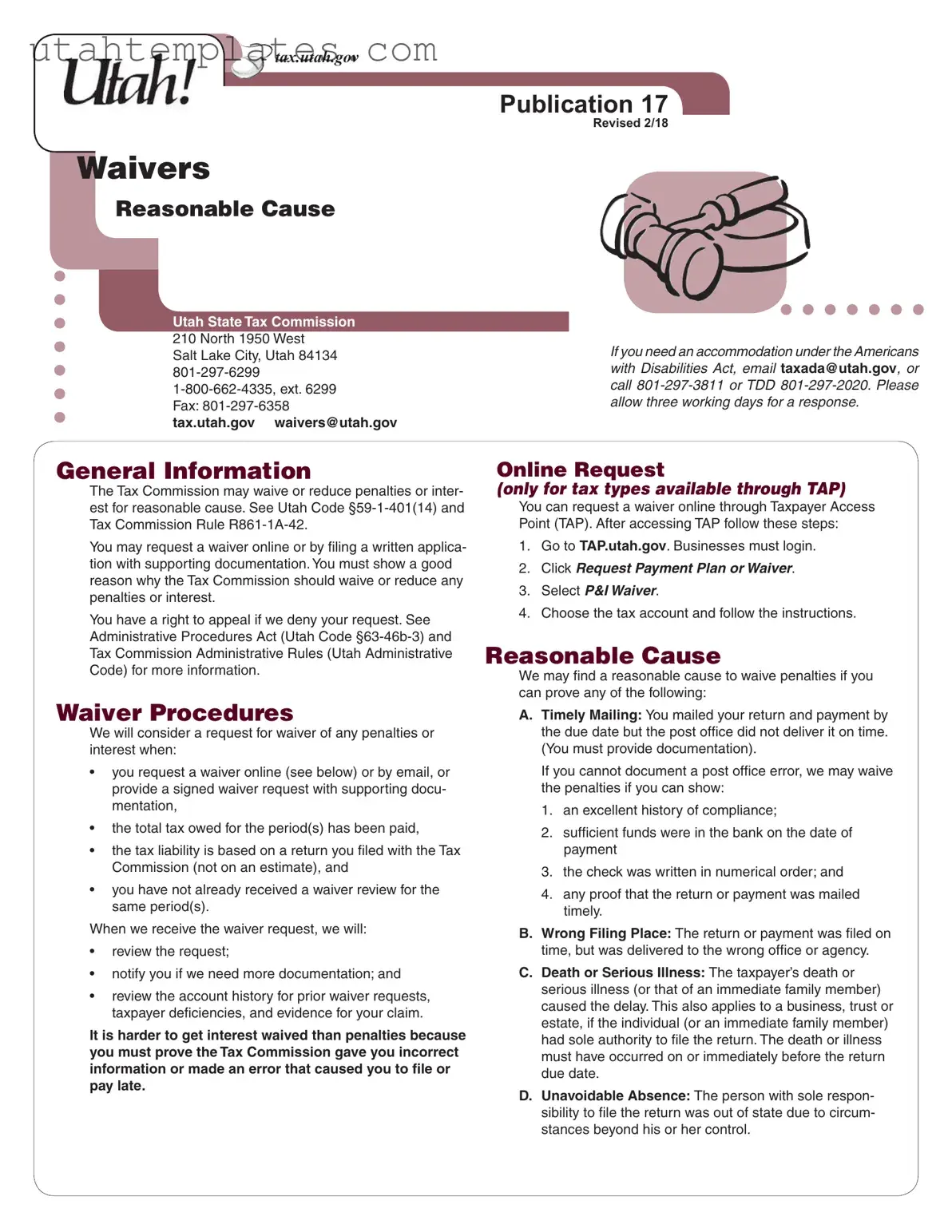
The Phone Number For Utah State Tax Commission form is an important document for taxpayers who seek to address penalties or interest assessed on their tax obligations. The Tax Commission has the authority to waive or reduce these penalties if there is reasonable cause. Taxpayers can request a waiver either online or by submitting a written application along with supporting documentation. To be considered, the total tax owed must be paid, and the request must be based on a return filed with the Tax Commission rather than an estimate. Various circumstances may qualify as reasonable cause, including timely mailing, serious illness, or reliance on incorrect information from the Tax Commission. It is essential to provide adequate proof for the claim, as waiving interest is generally more challenging than waiving penalties. Taxpayers also have the right to appeal if their request is denied. The form provides a comprehensive overview of the procedures and criteria necessary to submit a waiver request effectively.
Utah Dws Sds 305 - The DWS-SDS 305 is regularly updated to ensure it meets current employment needs in Utah.
To successfully initiate the homeschooling process in North Carolina, parents must complete the North Carolina Homeschool Letter of Intent form, which can be found at homeschoolintent.com/editable-north-carolina-homeschool-letter-of-intent. This essential document serves as a declaration of intent and helps ensure that families comply with state regulations regarding homeschooling, ultimately allowing parents to provide a personalized education tailored to their children's unique needs and learning styles.
Utah State Tax Forms - The TC-824 can facilitate smoother transition of vehicle titles in tricky situations.
| Fact Name | Details |
|---|---|
| Contact Information | The Utah State Tax Commission can be reached at 801-297-6299 or 1-800-662-4335, ext. 6299. For written inquiries, the mailing address is 210 North 1950 West, Salt Lake City, Utah 84134. |
| Reasonable Cause Waiver | Under Utah Code §59-1-401(14) and Tax Commission Rule R861-1A-42, the Tax Commission may waive or reduce penalties or interest for reasonable cause, provided that sufficient documentation is submitted to support the request. |
| Online Request Process | Taxpayers can request a waiver online through the Taxpayer Access Point (TAP) at TAP.utah.gov. A login is required for businesses, and specific steps must be followed to complete the request. |
| Appeal Rights | If a waiver request is denied, taxpayers have the right to appeal the decision according to the Administrative Procedures Act (Utah Code §63-46b-3) and the relevant Tax Commission Administrative Rules. |
When submitting the Phone Number For Utah State Tax Commission form, individuals may also need to complete several other forms and documents to ensure compliance with state tax regulations. Each of these documents serves a specific purpose and may assist in the process of requesting waivers or addressing tax-related matters.
Completing these forms accurately and providing the necessary documentation can significantly impact the outcome of a taxpayer's request. It is advisable for individuals to carefully review the requirements associated with each document to ensure a thorough submission process.
Filling out the Phone Number For Utah State Tax Commission form can be straightforward, but many people make common mistakes that can lead to delays or complications. One of the most frequent errors is providing an incorrect or outdated phone number. This mistake can hinder communication between you and the Tax Commission. If they need to reach you for additional information or clarification, an incorrect number can lead to missed opportunities to resolve your tax issues.
Another common mistake is neglecting to include an area code. In today's digital age, many assume that a local number is sufficient. However, without the area code, your number may not be recognized, especially if you are communicating with someone outside your local area. Always remember to include the area code to ensure your contact information is complete.
People also often forget to double-check their phone number for typos. A simple transposition of digits can change your number entirely, leading to confusion. Take a moment to verify that every digit is correct. Reading the number out loud can help catch any errors you might overlook when reading silently.
Lastly, failing to keep your contact information updated can create unnecessary challenges. Life changes, such as moving or changing jobs, often lead to new phone numbers. If you haven’t updated your information with the Tax Commission, they may struggle to reach you when necessary. Regularly review and update your contact details to avoid any potential issues down the line.

tax.utah.gov
Waivers
Reasonable Cause
Utah State Tax Commission
210 North 1950 West
Salt Lake City, Utah 84134
General Information
The Tax Commission may waive or reduce penalties or inter- est for reasonable cause. See Utah Code
You may request a waiver online or by filing a written applica- tion with supporting documentation. You must show a good reason why the Tax Commission should waive or reduce any penalties or interest.
You have a right to appeal if we deny your request. See Administrative Procedures Act (Utah Code
Waiver Procedures
We will consider a request for waiver of any penalties or interest when:
•you request a waiver online (see below) or by email, or provide a signed waiver request with supporting docu- mentation,
•the total tax owed for the period(s) has been paid,
•the tax liability is based on a return you filed with the Tax Commission (not on an estimate), and
•you have not already received a waiver review for the same period(s).
When we receive the waiver request, we will:
•review the request;
•notify you if we need more documentation; and
•review the account history for prior waiver requests, taxpayer deficiencies, and evidence for your claim.
It is harder to get interest waived than penalties because you must prove the Tax Commission gave you incorrect information or made an error that caused you to file or pay late.
PUBLICATION 17
REVISED 2/18
If you need an accommodation under the Americans with Disabilities Act, email [email protected], or call
Online Request
(only for tax types available through TAP)
You can request a waiver online through Taxpayer Access Point (TAP). After accessing TAP follow these steps:
1.Go to TAP.utah.gov. Businesses must login.
2.Click Request Payment Plan or Waiver.
3.Select P&I Waiver.
4.Choose the tax account and follow the instructions.
Reasonable Cause
We may find a reasonable cause to waive penalties if you can prove any of the following:
A.Timely Mailing: You mailed your return and payment by the due date but the post office did not deliver it on time. (You must provide documentation).
If you cannot document a post office error, we may waive the penalties if you can show:
1.an excellent history of compliance;
2.sufficient funds were in the bank on the date of payment
3.the check was written in numerical order; and
4.any proof that the return or payment was mailed timely.
B.Wrong Filing Place: The return or payment was filed on time, but was delivered to the wrong office or agency.
C.Death or Serious Illness: The taxpayer’s death or serious illness (or that of an immediate family member) caused the delay. This also applies to a business, trust or estate, if the individual (or an immediate family member) had sole authority to file the return. The death or illness must have occurred on or immediately before the return due date.
D.Unavoidable Absence: The person with sole respon- sibility to file the return was out of state due to circum- stances beyond his or her control.

E.Disaster Relief: A federal or
F.Reliance on Erroneous Tax Commission Information: You received incorrect advice from the Tax Commission that led to the underpayment, late payment or late filing. This does not apply if you gave the Commission inac- curate or incomplete information. Proof may be based on written communication from the Tax Commission or verbal communication (include dates, times and names of Commission employees who provided the information). We may excuse a failure to comply if you can prove you requested the necessary tax forms timely but the Tax Commission did not provide them timely.
G.Tax Commission Office Visit: You visited a Tax Com- mission office for information or help in preparing the re- turn before the due date, but Tax Commission employees were not there during Tax Commission business hours to help you.
H.Unobtainable Records: You were not able to get re- cords to determine the tax due, for reasons beyond your control.
I.Reliance on Competent Tax Advisor: You gave all your tax information to a competent tax advisor who gave you incorrect advice, failed to file a timely return on your behalf, or failed to make a timely payment on your behalf.
You must file returns. Relying on a tax advisor to prepare a return does not automatically create reasonable cause for failure to file or pay. You must give a tax advisor your tax information before a return’s due date. You must show you used normal care and diligence when you decided whether to seek further advice.
J.First Time Filer: You were late in filing the first return you were required to file, but paid the tax within a reasonable time. The Tax Commission may also waive penalties on the first return after a filing period change if you filed and paid in a reasonable time.
K.Bank Error: Your bank made an error in returning a check, making a deposit or transferring money. Provide a letter from your bank explaining the error.
L.Employee Embezzlement: An employee(s) embezzled tax funds and you couldn’t get funds from any other source.
M.Recent Tax Law Change: You didn’t file or pay because you were not aware of a recent tax law change. You must prove you could not be expected to know of the change.
The Tax Commission considers your recent account history when we decide whether or not to waive a penalty. We also consider whether other tax returns or reports are overdue when you request the waiver.
Other factors may affect whether we find reasonable cause. These include:
•whether the Tax Commission had to take legal means to collect the taxes
•whether you caught and corrected your own error(s)
•the length of time between the event and the filing date
•typographical or other written errors, and
•other clearly supported extraordinary reasons for filing or paying late which show reasonable cause and an inability to comply.
In most cases, ignorance of the law, carelessness or for- getfulness does not create reasonable cause. Intentional disregard, evasion or fraud does not constitute reasonable cause under any circumstance.
Each case is judged on its individual merits.
Waiver Request
A
•the
•the
The waiver request must include all
See Utah Code
This publication is to be used as a guideline only, and does not reflect the complete
standards for waiver of penalty and/or interest.
17
PAGE 2
When dealing with the Phone Number For Utah State Tax Commission form, there are several important points to keep in mind. These takeaways will help ensure that you understand the process and requirements involved.